

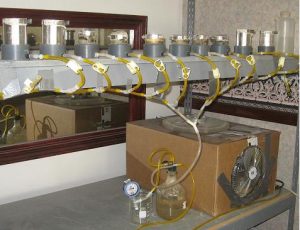
Relative Brine Release Capacity Rapid Screening Test
DBS&A’s Soil Testing and Research Laboratory developed a rapid screening test for relative brine release capacity (RBRC) using samples from lithium mining sites in the U.S. and abroad. RBRC testing is used to estimate the brine released by pumping a brine-saturated geologic unit.
The method has been adopted as the industry standard. DBS&A developed it in conjunction with the University of New Mexico’s Department of Civil Engineering. Our laboratory has performed over one thousand RBRC tests for more than 18 major international mining companies. Clients use lithium extraction to collect brine from sites in core samples as small as 2.5 inches by 4 inches.
To conduct RBRC testing, laboratory technicians apply a vacuum to the group of saturated samples in a parallel configuration, allowing rapid analysis of 10 samples. The amount of brine produced in response to the vacuum (i.e., RBRC) provides a basis for comparison of the amount of brine produced from different samples. The RBRC is related to the specific yield of a material, a principal function of material texture.